A clear pool can still be out of balance. You may see sparkling water and assume everything is fine, only to notice burning eyes, a rough tile line, fading chlorine, or algae showing up a few days later.
Good pool water chemistry is less about chasing perfect numbers and more about keeping the system working together. Sanitizer, pH, alkalinity, minerals, stabilizer, circulation, and filtration all affect how your water behaves.
In Florida, that balance can shift fast. Strong UV, warm water, heavy use, and sudden rain all change what your pool needs.
Why Clear Water Is Not Enough
The biggest reason to care about pool chemistry is simple: clear water does not automatically mean safe or balanced water.
Your swimming pool needs enough sanitizer to control germs, but it also has to work under the right conditions. The CDC treats chlorine and pH as the first line of defense and recommends regular testing because sunlight, swimmers, and contaminants can lower available chlorine.
Balanced Water Helps Keep the Pool Safe for Swimmers
Your sanitizer has to stay available long enough to do its job. Free chlorine is the active portion that helps control many germs and organic contaminants introduced by swimmers.
A treated pool is not sterile. Some germs tolerate chlorine longer than others, so appearance alone is not enough. You want a measurable chlorine residual and a pH that lets sanitizer work effectively.
Balanced Chemistry Makes Swimming More Comfortable
Red eyes do not always mean you added too much chlorine. Poor pH levels and chloramines can make swimming uncomfortable, especially after a busy weekend.
A strong pool smell can point to chlorine reacting with contaminants. If you respond by blindly adding pool chemicals, you may treat the symptom instead of the cause.
What Throws Your Pool Water Out of Balance?
Your pool changes every day, even when nobody touches the equipment.
Sunlight breaks down chlorine. Swimmers add sweat, sunscreen, oils, and debris. Evaporation can concentrate dissolved material, while refill water brings its own mineral profile.
Then Florida weather adds another layer. Torrential rain can dilute chemical levels, lower salt concentration, introduce debris, and sometimes push the water over the coping.
Why Florida Sun, Heat, and Heavy Rain Change the Equation
Florida conditions make pool chemistry more active, not more complicated.
Strong sunlight reduces available chlorine, while warm water and frequent swimming raise demand. Heavy rain can also change the volume and makeup of your pool water. Much of west-central Florida sees a rainy season that runs from late spring into early fall.
After a major storm, test before you react. You do not need to automatically shock the pool just because it rained.
If the water level becomes a problem, review how to safely drain a pool after heavy rain before removing excess water.
The Water Levels You Actually Need to Understand
The easiest way to manage pool chemistry is to stop treating every test result as a separate problem.
Your readings interact. Chlorine can look fine while high pH makes it less effective. Calcium may sit within a common range while the overall water balance still encourages scale.
Free Chlorine: The Sanitizer Doing the Actual Work
You want enough free chlorine to control contamination without guessing from the water’s appearance.
The CDC recommends at least 1 ppm free chlorine in a residential pool without cyanuric acid and at least 2 ppm when cyanuric acid or stabilized chlorine is used. It also recommends a pH between 7.0 and 7.8.
Your target can vary with the sanitizer system, product label, and operating conditions. Keep a dependable sanitizer level instead of assuming one number fits every pool.
pH: Why Chlorine Performance, Comfort, and Equipment Protection Are Connected
Your pool’s pH level affects swimmer comfort, sanitizer performance, and the way water interacts with surfaces and equipment.
As pH rises, chlorine effectiveness drops. If pH becomes too low, acidic water can become more aggressive toward metal and other materials. The CDC notes that pH above 8.0 reduces chlorine’s germ-killing ability, while pH below 7.0 raises corrosion concerns.
pH is not a cosmetic number. It changes how the rest of your water behaves.
Total Alkalinity: The Buffer Behind More Stable pH
Total alkalinity helps keep pH from swinging every time something changes in the water.
If alkalinity is too low, pH can move quickly. If it runs too high, pH can become stubborn, and scale-forming conditions may become harder to control.
Before you repeatedly adjust pH, check alkalinity. Constant acid additions without understanding the buffer can turn routine care into a cycle.
Calcium Hardness: Protecting Pool Surfaces Without Encouraging Scale
Calcium hardness does not sanitize your water, but it matters for plaster, grout, heaters, and other surfaces.
Water with low calcium hardness can gradually draw calcium from plaster, grout, and other cement-based pool surfaces, leading to premature wear. On the other hand, high calcium hardness combined with high pH and alkalinity can encourage scale and cloudy water.
Calcium hardness works as one part of the full pool water balance, not as a stand-alone target.
Cyanuric Acid: Useful Sun Protection, but More Is Not Better
Cyanuric acid acts as a stabilizer in an outdoor pool because it helps protect chlorine from the sun’s UV rays.
That protection matters in Florida, but more is not always better. As CYA rises, chlorine behaves differently, so higher stabilizer levels also affect how much active chlorine the pool needs.
Before you add stabilizer, test what is already there. Repeated use of stabilized chlorine products can add CYA over time.
How Saltwater Pool Systems Change the Way Chemistry Is Managed
A saltwater system makes chlorine for you, but it does not remove the need to manage pool chemistry.
The salt cell uses dissolved salt in the water to produce chlorine. You still need to watch chlorine levels, pH, alkalinity, CYA, calcium hardness levels, and salt. In many saltwater pools, pH can trend upward.
Scale is another concern. Deposits can build on cell plates and reduce chlorine production, while heavy rain or large water replacement can dilute salt.
If you are weighing an upgrade or dealing with recurring salt-cell issues, see saltwater pool systems in Orlando.
Total Dissolved Solids and Phosphates: Useful Clues, Not Numbers to Chase Blindly
Total dissolved solids tells you about substances dissolved in the water. It does not mean undissolved debris.
A high TDS reading adds context, but it should not distract you from sanitizer, pH, alkalinity, calcium, CYA, circulation, and filtration. Phosphates can support algae growth, but treatment does not replace sanitation.
How to Tell When Your Water Is Out of Balance
You usually notice the symptoms before you understand the cause.
Watch for cloudy pool water, recurring algae, fast chlorine loss, scale, staining, unstable pH, corrosion, or a strong chemical odor. Irritated eyes or skin rashes also deserve attention.
When the Problem Is More Than Add More Chlorine
More chlorine will not fix every water problem.
If sanitizer disappears quickly, your pool’s filtration system may be struggling, circulation may be weak, CYA may be high, or the salt cell may not be producing as expected.
How to Maintain Proper Pool Chemistry in Florida
The most reliable way to maintain pool chemistry is to follow the same sequence every time: test, interpret, adjust, circulate, then retest.
Step 1 — Test Before Adding Chemicals
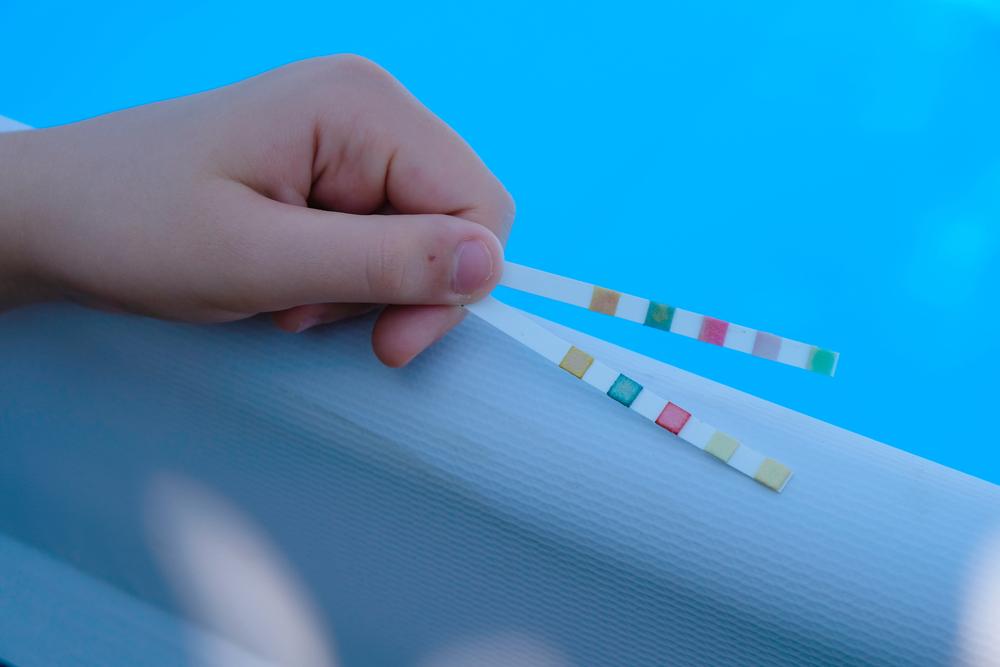
Never guess from water color alone. Take a representative pool water sample before adding pool chemicals. Start with sanitizer and pH, then review alkalinity, CYA, calcium hardness, and salt where applicable.
Step 2 — Look at the Numbers Together, Not One at a Time
Your goal is balanced pool water chemistry, not a row of individually perfect test blocks. High pH, high alkalinity, warm water, and elevated calcium can create scale together. Low pH and weak buffering can make water more aggressive.
Step 3 — Make One Controlled Correction at a Time
Small, measured changes are easier to manage than a large chemical swing. Your dose depends on pool volume, starting value, target value, and product concentration. The same amount of sodium bicarbonate or sodium carbonate can affect two pools differently. Follow the label, circulate, and retest before another major correction.
Step 4 — Retest After Florida Downpours and Heavy Pool Use
A storm or crowded weekend can change the water faster than your normal schedule expects. Retest after heavy rain, overflow, large gatherings, heavy debris, or major water replacement.
Step 5 — Keep Circulation, Filtration, and Chemistry Working Together
Your chemicals cannot do all the work if water is barely moving. Dirty pool filters, a weak pump, or poor circulation can leave sections under-treated. Salt cells also depend on proper flow. If the water stays dull after the readings look reasonable, inspect the equipment side instead of adding other pool chemicals.
Common Chemistry Mistakes That Create Bigger Problems
Adding Chemicals Without Testing First
Guessing often creates a second problem. You may raise pH when alkalinity is already high or add stabilizer when CYA is already elevated. Test first and treat the condition you actually have.
Treating Weekly Shock as a Rule for Every Pool
A fixed weekly pool shock schedule does not fit every pool. Your need for corrective treatment depends on swimmer load, contamination, sanitizer demand, system type, and test results. Use the water, not the calendar alone.
Correcting pH Without Looking at Total Alkalinity
If you keep fighting the same pH problem, check alkalinity. A poorly buffered pool can bounce after every correction. On the other side, high alkalinity can make pH harder to move.
Adding Stabilizer Without Checking Existing CYA
Florida sun makes stabilizer useful, but blindly adding more can work against you. Know the current level before dosing. Stabilized tablets or granules can raise CYA over time.
Ignoring Salt Cell Scale in a Saltwater Pool
Salt concentration is only one part of saltwater care. A scaled cell can struggle even when the controller shows enough salt. If production falls, inspect the cell and review water balance rather than assuming the generator has failed.
Assuming Clear Water Means Balanced Water
Clear water is a good sign, not a complete test result. Poor pH, weak sanitizer, excessive CYA, or scale-forming conditions can exist while the water still looks fine. Routine testing catches them earlier.
What Balanced Water Protects Over the Long Term
Good pool chemistry protects far more than the water itself.
Poor balance can scale tile, heaters, and salt cells. Aggressive water can affect metal, grout, plaster, and other pool surfaces. Over time, both can shorten the useful life of pool equipment.
When You Need a Professional Diagnosis
You should bring in a professional when the same problem keeps returning despite reasonable corrections.
Recurring algae, disappearing chlorine, stubborn pH, scaling, staining, or salt-cell trouble often point to a deeper issue involving chemistry, circulation, filtration, or equipment.
Professional Aquatic Services can help you sort those variables out instead of staying in a trial-and-error cycle. PAS can evaluate the water, equipment, and saltwater system so you can act on the actual cause.
If you are tired of correcting the same issue every week, contact Professional Aquatic Services or schedule a pool evaluation.
Keeping Pool Water Balanced in Florida Is an Ongoing Process
Your Florida pool rarely stays unchanged for long. Sun, storms, heavy use, refill water, and equipment performance can all shift your readings.
Your best defense is consistency. Test before you treat, make controlled adjustments, watch the equipment, and retest when weather or use changes suddenly.
Saltwater automation does not remove that responsibility. It simply changes how chlorine is produced.
With steady care, you can protect swimmers, reduce wear, and keep your pool ready to use without turning every small change into a chemical emergency. If you need help finding the source of a recurring problem, schedule a pool service evaluation.
Frequently Asked Questions
Do I really need to wait 4 hours between pool chemicals?
Not always. There is no universal four-hour waiting rule for every pool chemical. The correct wait time depends on the products being used, water circulation, dosage, and the manufacturer’s directions.
Never mix different pool chemicals together, especially chlorine and acid. Add products separately and allow each one to disperse according to its label before making the next adjustment. CDC guidance specifically warns against mixing pool chemicals because incompatible products can create dangerous reactions or toxic gases.
What does baking soda do for pool chemistry?
Baking soda, also commonly known as sodium bicarbonate, is mainly used to raise total alkalinity, which helps stabilize pH and prevent rapid swings in the water. It can be useful when alkalinity is low, but the amount added should depend on your current test results and pool volume.
For a deeper explanation of when and how it is used, read our guide to baking soda for pools.
In what order should I put chemicals in my saltwater pool?
There is no single chemical order that applies to every saltwater pool, because you should test the water first and correct what the results actually show. In general, you want pH, total alkalinity, calcium hardness, stabilizer, sanitizer, and salt within the ranges required by your specific salt chlorine generator.
Do not add several chemicals at once simply to reach target numbers faster. Make controlled adjustments, allow the water to circulate, and retest when needed. Salt-system manufacturers also stress maintaining overall water balance because improper chemistry can encourage corrosion or scaling on the salt cell and other equipment.